By Winston Margaritis
April 20, 2026
“The beating heart of Rome is not the marble of the Senate; it’s the sand of the Coliseum. He’ll bring them death, and they will love him for it.” – Gracchus, in Gladiator
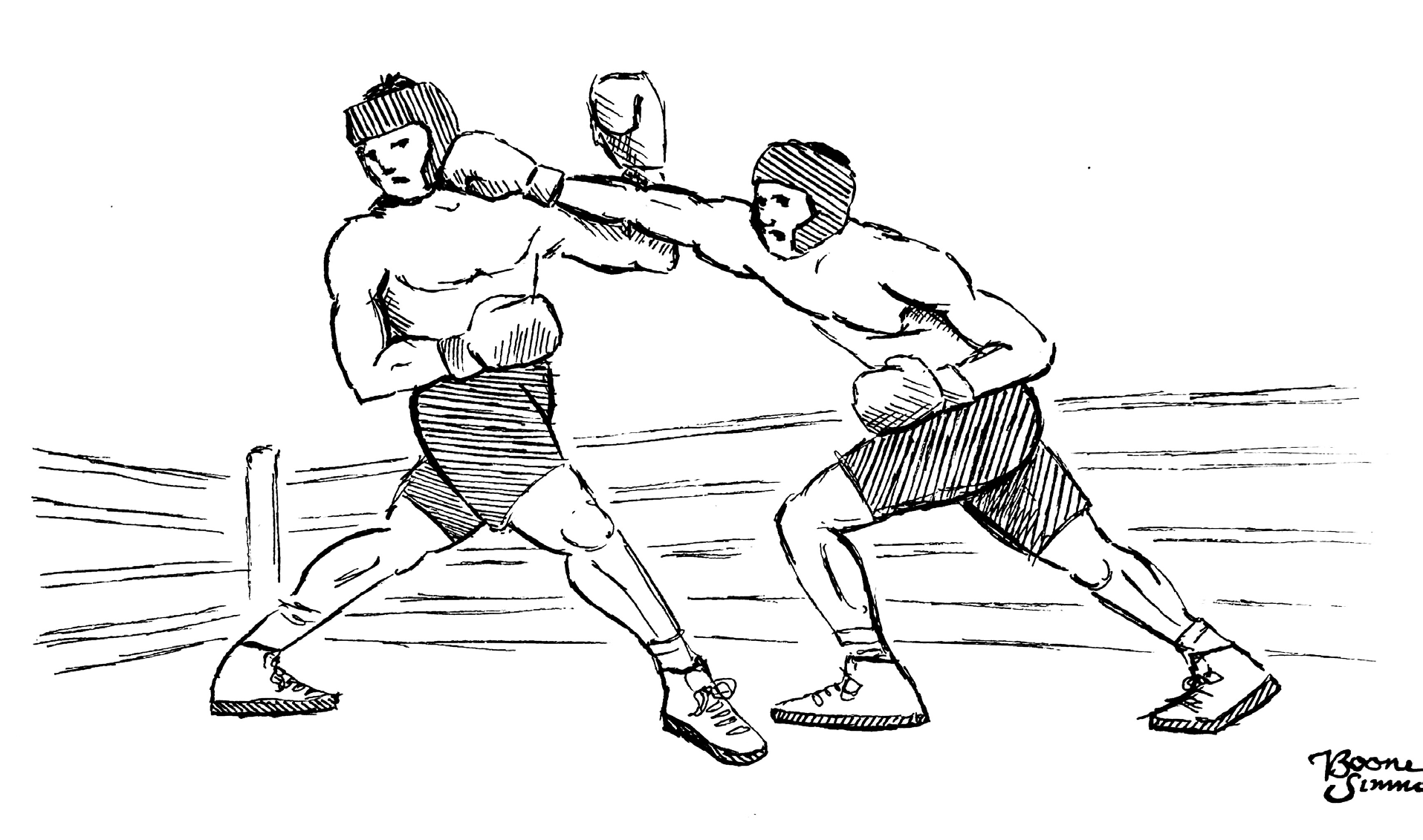
Greg Chang, his hands up, his feet dancing, slips a punch meant for his temple.
Greg weaves, ducks, shuffles, eluding another volley of long-reaching blows from his tall, worn-out opponent. Greg is shorter, but faster, untouchable, his shifty feet a blur of constant motion on the canvas.
The crowd impatiently screams for blood. They can sense the weakness, the fragility, the fatigue growing as the round stretches on. “FINISH HIM!” my incensed neighbor yells, nearly shattering my eardrum.
Greg stays patient, waiting for his moment. His opponent, tired and bloody from Greg’s energizer-bunny jabs, takes a mighty, but sloppy swing, going for broke. Greg, ever elusive, dodges and sees the opening. This is it. In a flash, he counters, stepping in, thrusting up from his heels, seeming almost to launch off the ground, the pent-up energy rising through his uncoiling legs and torso, as if traveling up a spiral staircase, then releasing outwards through his hooking, compact, muscled arm to fill the open gap with a red-gloved fist.
The devastating blow will be his last, though he doesn’t know it yet. His weary opponent watches the incoming devastation of leather, and appears to, in the milliseconds before impact, surrender to it, as though welcoming his own magnificent defeat.
As Greg’s fist rushes to crack his opponent’s vulnerable nose, the audience is swelling, wailing, jumping, writhing: “YEAHHHH!”
Greg’s fist connects, hitting so hard it dislodges his opponent’s headgear a quarter-turn and rebounds his neck to and fro like a bobblehead. Everyone loses it: “COME ON GREG, END IT!” His opponent’s hands drop slightly. He looks confused, swaying, blinking, as though just awoken from a long nap. As Greg winds up his piston for the lethal coup de grâce, the ref rushes in, breaking up the combatants, shielding the dazed man from ultimate ruin. It’s bedlam. Pandemonium. Drinks are spilling on me. The ref counts, steadies the man’s head, and looks deep into his eyes. With one wave of his arms, he signals both victory and defeat. It’s over. TKO.
The decibels spike to a deafening volume. Greg dances around the ring, vaults onto the ropes, yelling to the crowd, unleashing months of emotion, pounding his chest, sweat and spit flinging off him as he does, shining stark-white in the fluorescent light. With every pound of his chest, they woot and scream. They’re shoving, pressing in to get a better view, taking pictures. The grizzled, disgruntled bouncers drive them back. Greg has the crowd in his grip. He has trained for this moment, dreamed of it. Now, he is on top of the world. He has brought them a knockout, and they love him for it.
•
The event is incredibly organized. Ring girls, coaches, security, entourages, walk-out music, two fully manned bars, a live-stream setup, a projector showing active betting odds, and even a band in the corner for intermissions. The card lists 10 fights: 5 men’s, 5 women’s. This is far from a backyard brawl. It feels like a real Vegas fight with legit production value.
Months of planning and coordination by The St. Andrews Fight Club has culminated into this glorious Fight Night.
•
It’s hot as hell in here. Always is at any social event in St. Andrews. Even though it’s freezing outside on this March evening, the density of bodies packed together generates enough heat to break a sweat on my forehead. It’s not helped by the fact that we are all wearing suits and ties. But I love it. It feels like the roaring ‘20s.
This is by far the most barbaric event on our social calendar. But it’s important. We all paid a non-trivial sum for a ticket to be here. A funny juxtaposition, students all dressed up in their finest clothes to witness the most primitive of events.
We St. Andrews students pride ourselves on being civilized, distinguished, classy, genteel, even Aristocratic. Every day, we are mostly mild-mannered, reserved, deferent, proper. We agree with King Henry, “In peace there’s nothing so becomes a man as modest stillness and humility.”
But once a year, when the bell dings at Fight Night, we discard formalities and go feral:
“When the blast of war blows in our ears,
Then imitate the action of the tiger;
Stiffen the sinews, summon up the blood,
Disguise fair nature with hard-favour’d rage;
Then lend the eye a terrible aspect”
We crowd in, like moths to a flame, squeezing towards the ropes, peering over heads on tippy toes to catch a better glimpse of the action. Everyone is angling for a vantage point: we stand on the stairs, on railings, on speakers, on upturned trash cans. We loosen ties and curse freely.
We can’t wait to see our peers wage war against one another. We stoke the carnage in all its glory.
What draws us to this pugilistic affair? Is it a base appetite for violence? Or could it be something higher, something more profound? Something like…virtue?
•
Historically, fighting was used to settle disputes. Somewhere along the way, it became a sport. At its best, it might even be an art.
What if boxing is a ground for moral training? What if it could teach you more about morality, character, and virtue than any philosophy class ever could?
The ring is where your ideas about yourself go to be tested. You can philosophize about virtue all you want in abstraction, but, as Mike Tyson said, “Everybody has a plan until they get punched in the face.”
Boxing represents various virtues: courage, strength, fortitude. But it’s also about restraint and self-discipline. You can’t fight recklessly, over-aggressively. You must be poised, embodying Aristotle’s golden mean: Nothing in excess, everything in moderation.
There is an inherent urge to fight and defend. As long as humans have lived, we have fought and have watched others fight. It’s a tradition, hearkening back to boxing in the Olympics in Ancient Greece and the gladiators of Ancient Rome.
•
Participating in Fight Night is no spur-of-the-moment decision. Fighters train for months and deeply desire victory. It’s a way to prove themselves to themselves, and to the whole university at large. There’s a lot at stake to those who don the gloves and step into the ring.
Second-year Max “The Tennessee Titan” Kohler (as he was known in last year’s bout) reflects, “I was training minimum four times a week and truly felt like an athlete. It was so consuming both mentally and physically. I totally put the pressure on myself, but I felt like I had something to prove.”
Kohler goes on, “Walking out was such a surreal experience. People were touching me and yelling in my face, but it sounded completely silent. I couldn’t hear anything other than my own thoughts.”
•
The idea of proving oneself immediately makes us uncomfortable. We are all told we are already good enough. Our whole culture has been carefully designed to convince us so. We are all too coddled, afraid, and soft.
We are now at an event, Fight Night, where the object of the game is literally to see who the tougher contender is, who can withstand more hurt, who can deliver more vicious blows, who is stronger.
Because of this, boxing is a profound instructor. Second-year Kate “Terror” Thompson explains, “My biggest surprise was seeing how much I could take. I thought I would back away and be scared, but as soon as I got hit, I realized I was much stronger than I thought, and I could throw a punch harder than I thought, too. It was cool seeing the development of getting so much stronger. I found out a lot more about myself.”
Boxing may just be the simplest, purest test of character, nerve, and willpower. It’s just two people in a ring, and the one who can marshal better equanimity, strategy, and resolve wins. We love that. It’s unambiguous and refreshing in a world full of confusing filters, red-tape, and doublespeak.
It’s anathema to the cultural tides of today. And yet, we love it. We love the more muscular worldview boxing offers. We yearn for it, clamor for it, but are deprived of it. We shout and shove and foam at the mouth for it.
We love the risk of boxing. We love how fighters willingly subject themselves to danger. You could get hurt. You will get hurt. It’s dangerous, strenuous, and real in a world that is often too safe, too convenient, and too simulated.
Boxing at first glance may look barbaric, uncivilized, and chaotic, but it contains embedded order and strategy. There are rules of civility that participants follow, both written and unwritten. The demanding nature of the sport engenders mutual respect among opponents.
During this year’s Fight Night, I witnessed foes intensely battle, then embrace after the final bell, sweatily congratulating each other on a valiant fight well fought. Even when someone lost, I often heard, “I really respect them for getting out there.” There’s a nobility, an admiration for just entering the arena, for just having the intestinal fortitude, even in defeat.
In a society so empty, timid, and anti-competitive, we desire just a little bit of real danger, ruggedness, and grit. We want a hero to risk it all, to subdue their opponent, to win. Someone who truly answers the charge of Ever to Excel. We see in the ring a valorous warrior, what we were meant to be, what we aspire to, what we have lost. For one fleeting night a year, we St. Andrews students revivify an ancient tradition and see a lively glimmer of true virtue.
Fight Night is exactly the type of event that would get cancelled by the risk-management department because of “liability” concerns. But in art, sports, and love, without risk, there can be no intrigue, no story, no hero.
The beating heart of the University of St. Andrews lies in its many wonderful traditions. Some have faded away, others barely hang on, the rare few still thrive. May the tradition of Fight Night continue next spring. Once more unto the ring, dear friends, once more…and forevermore.
 The Martyr